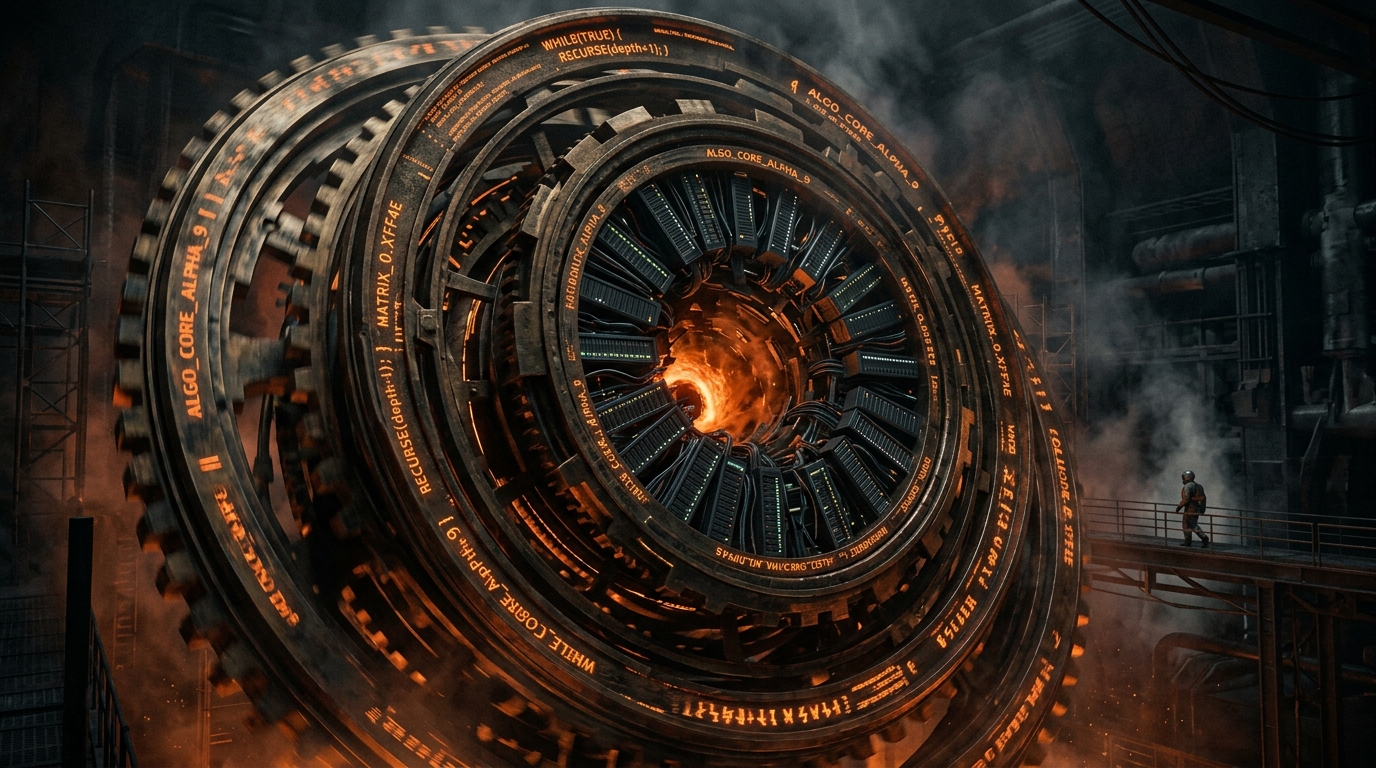

“The Supreme Lord dwells in the hearts of all living beings, O Arjuna, causing them to revolve by His illusory power, as if mounted on a machine.” — Bhagavad Gita, Chapter 18:61
“I am Time, the great destroyer of worlds.” — Bhagavad Gita, 11:32
*This is the second installment of a three-part narrative. If you have not yet entered the maze, start with * Part One: The Wound**.
Don’t have the time to read the entire article? You can listen to it here.
PART TWO: THE FORMATION
For twelve days, the Kuru-Kshetra war remained legible.
Armies faced armies. Command structures held. Violence, however brutal, remained linear. On the thirteenth day, the battlefield changed shape. Dronacharya, teacher to both warring sides but fighting on the side of Kauravas, architected and deployed the Padmavyuha. And as a consequence, the war stopped behaving like an army and began behaving like a distributed system.
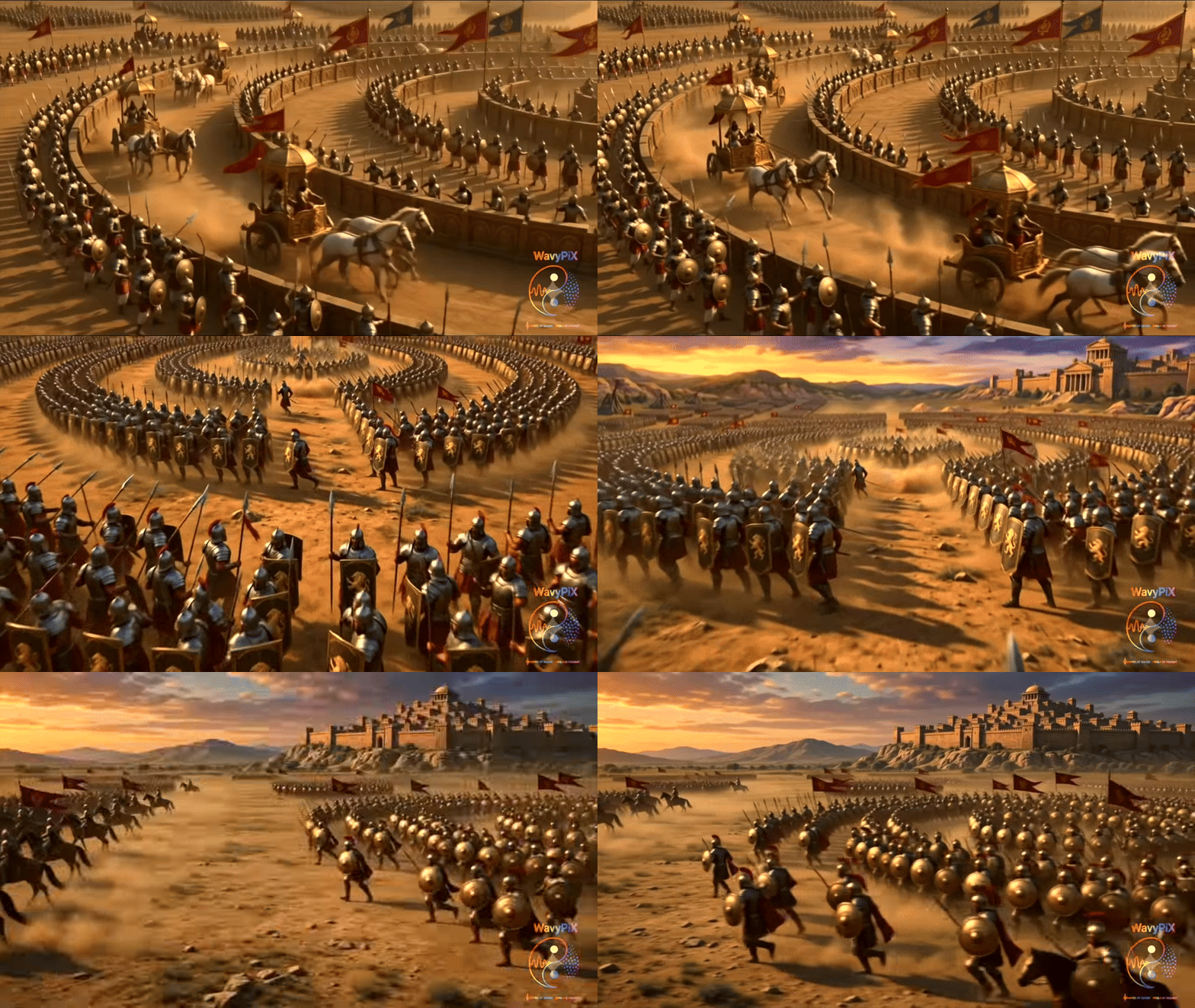
There was no center to strike. Each section absorbed damage and regenerated inward. The formation carried its intelligence in movement rather than command.
A system without a center cannot be cleanly broken.
“An arrow shot by an archer may kill a single person or even none, but an intrigue devised by a wise man can destroy even those who are yet unborn.” — Chanakya, Artha-Shastra
Civilizations repeatedly rediscover this structure.
Centralized systems maximize capability — concentrating intelligence, logistics, force, decision-making into a singular point. At the same time, these systems optimized for capability accumulate fragility at the same rate. And when survival becomes the priority, architecture shifts. It distributes. The mission lives inside the tiles. Even when the hub goes dark, the tiles continue.
History keeps paying, for this lesson. Decentralized networks have outlasted materially superior forces with a consistency that should, by now, have settled the argument. You are not fighting an opponent. You are fighting topology. Trying to defeat a mosaic by striking its strongest point is like fighting an ocean by punching the waves. Every punch lands. The ocean does not notice.
“Military tactics are like water. Water retains no constant shape.” — Sun Tzu
This is no longer only a question of war. It is now a question of computation.
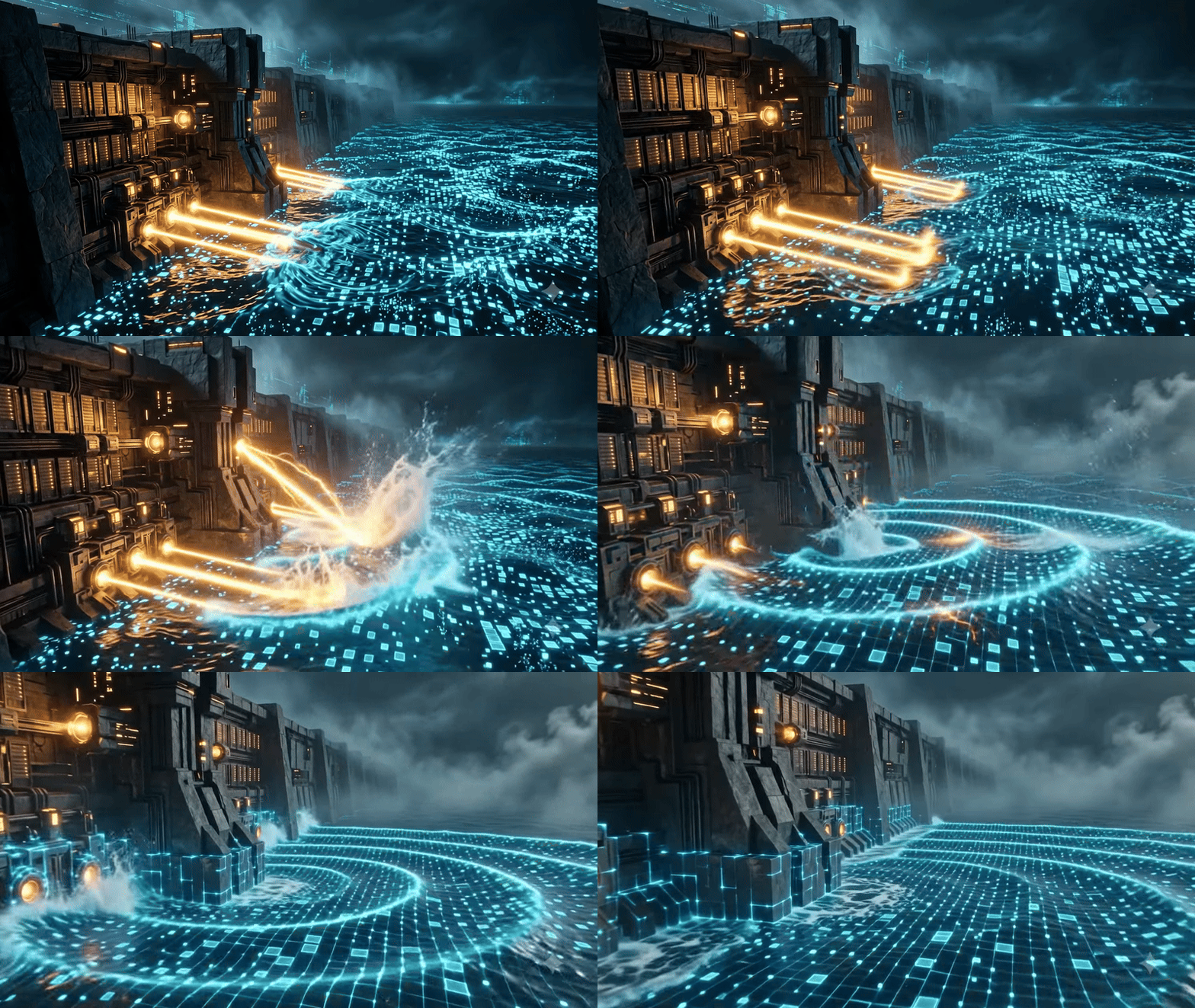
Modern cloud systems concentrate intelligence into massive infrastructures because concentration produces capability at scale. AI systems amplify this further — aggregating behavior, data, and inference into centralized learning systems that grow more powerful as more users feed them.
Capability expands upward. Sovereignty rarely does.
The asymmetry is simple. One side sees the formation. The other sees only the entrance.
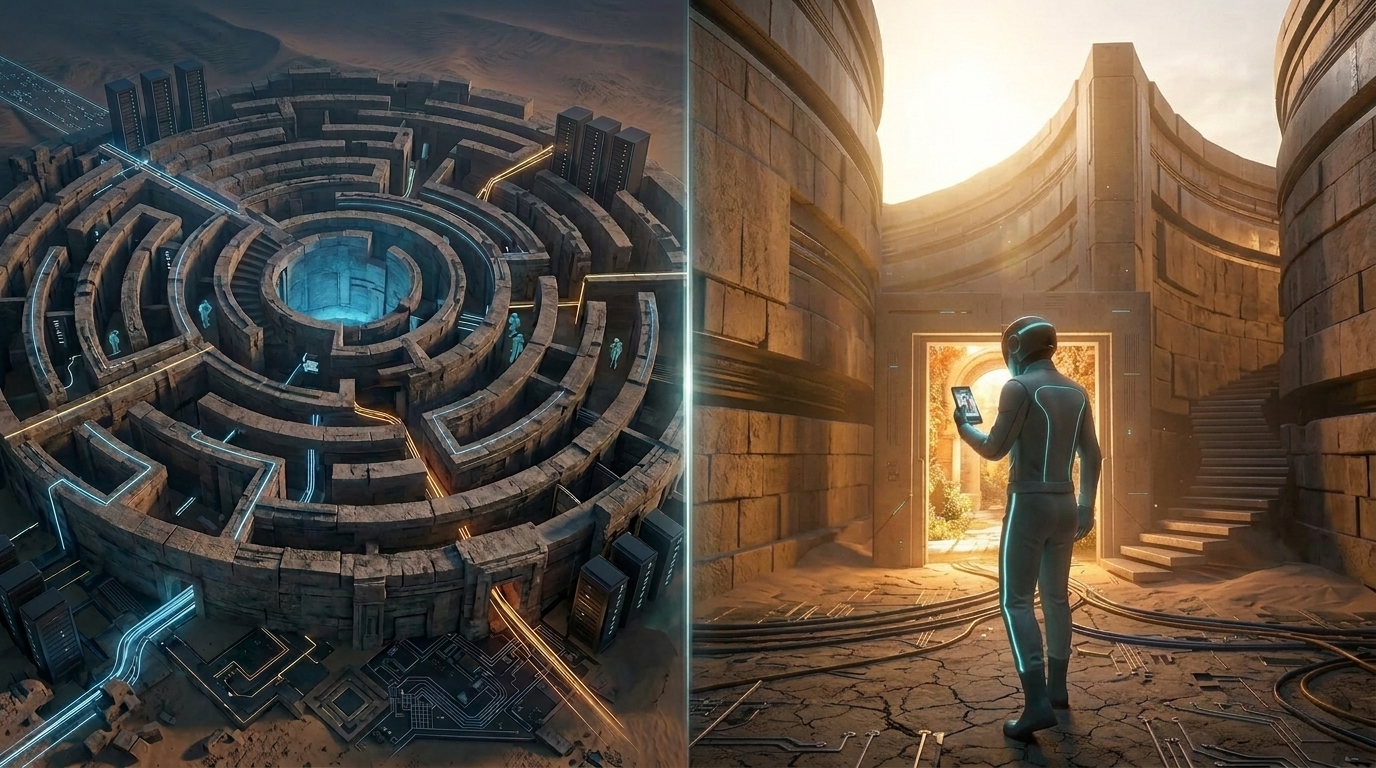
A few verses after describing humanity as ‘pieces mounted on a cosmic wheel’, Krishna alters the architecture entirely. He hands the map back over: “Reflect on this fully, and then act as you choose.” — Bhagavad Gita 18:63.
Inside the formation, Abhimanyu kept moving. Ring after ring collapsed before him. His kills were real. His progress felt real. But the formation absorbed brilliance the way an ocean absorbs fire. Each breach closed behind him. Fresh warriors rotated inward.
He was no longer advancing through the formation. The formation was processing him.
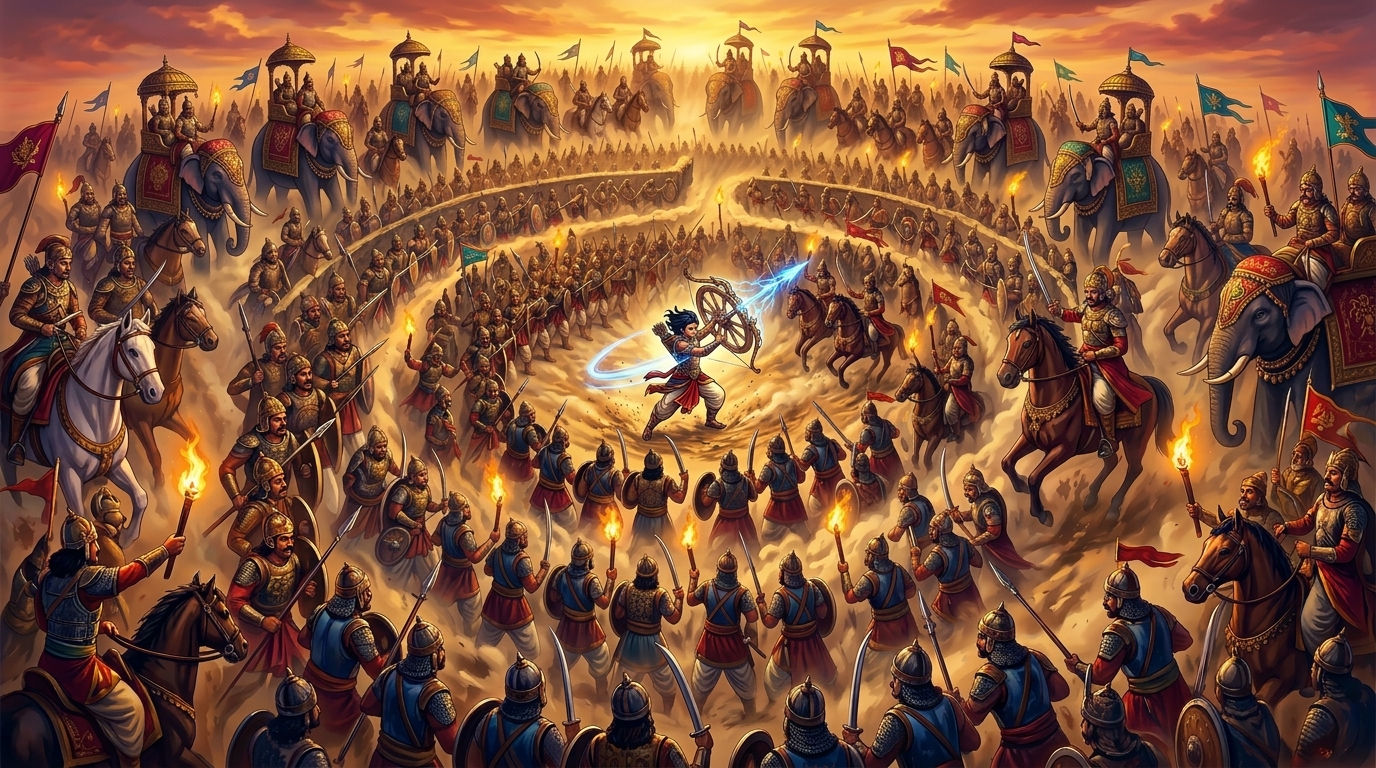
At some point on that long afternoon, he understood. Not the exit — he never found that — but the nature of what he was inside. Not a puzzle. Not a collection of enemies. A machine designed to continue until he stopped.
In computer science, recursive systems without a base condition fail. They call themselves again and again until the system collapses under its own continuation. The Padmavyuha was recursion in physical form. Abhimanyu had entry logic. Not exit logic. That is the entire tragedy.
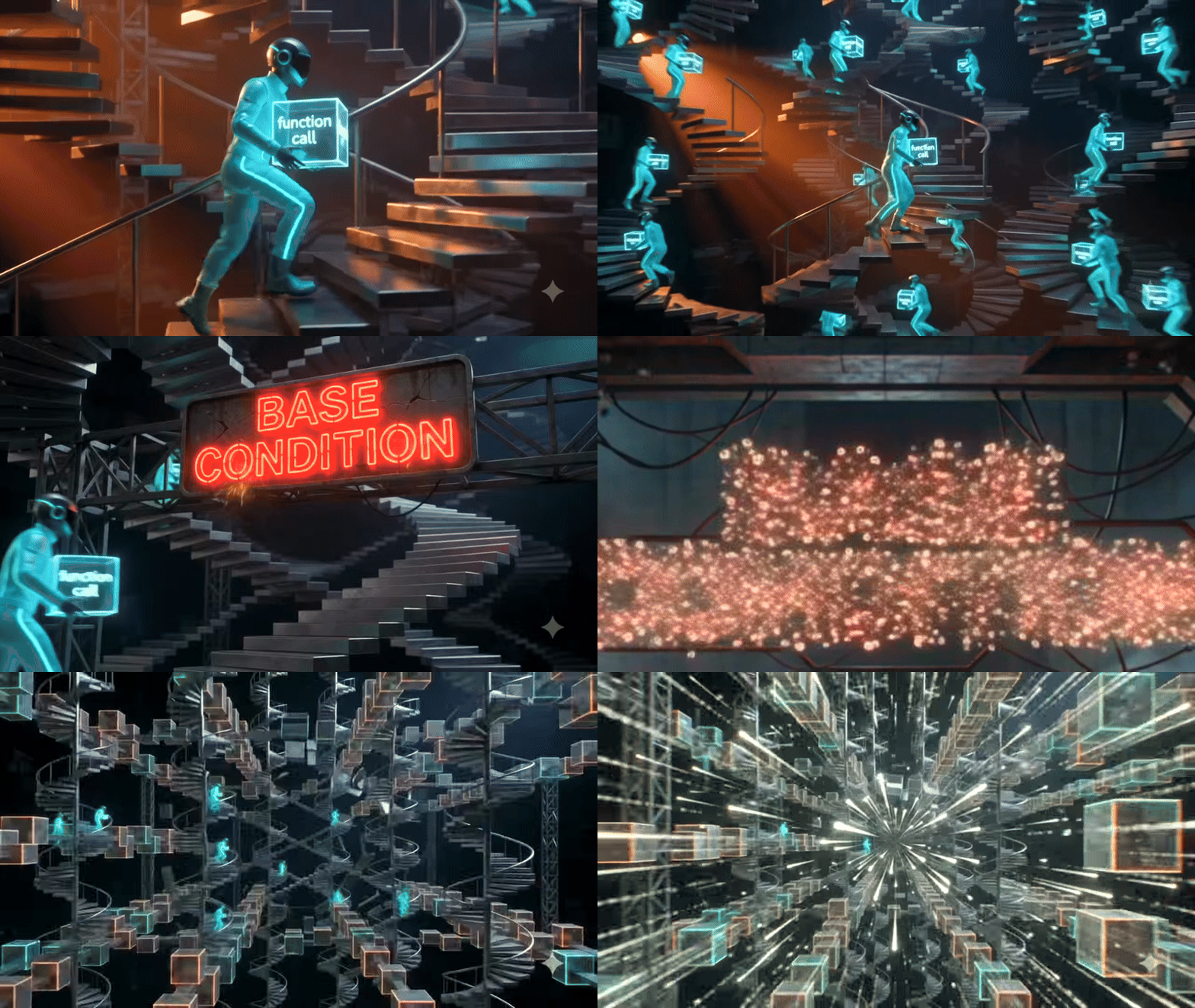
A base condition failure is rarely a passive omission. In the most hostile architectures, the exit logic is completely visible right up until the exact millisecond of execution.
Modern systems increasingly resemble this structure. Agentic AI pipelines, cloud dependencies, algorithmic economies — systems that operate beyond human supervisory continuity. They are powerful because they are continuous. But continuity without exit is instability delayed, not avoided.
The deepest danger is not failure. It is the point where stopping a system requires breaking its rules.
That is where Abhimanyu dies. Not in fair combat. But when the formation can no longer process him within its own logic. The rules collapse to end the loop. The great Kaurava warrior Karna strikes his bow from behind. Multiple warriors attack simultaneously. Every code of dharmic warfare broken in concert.
And once rules break to resolve a system, they do not fully return.
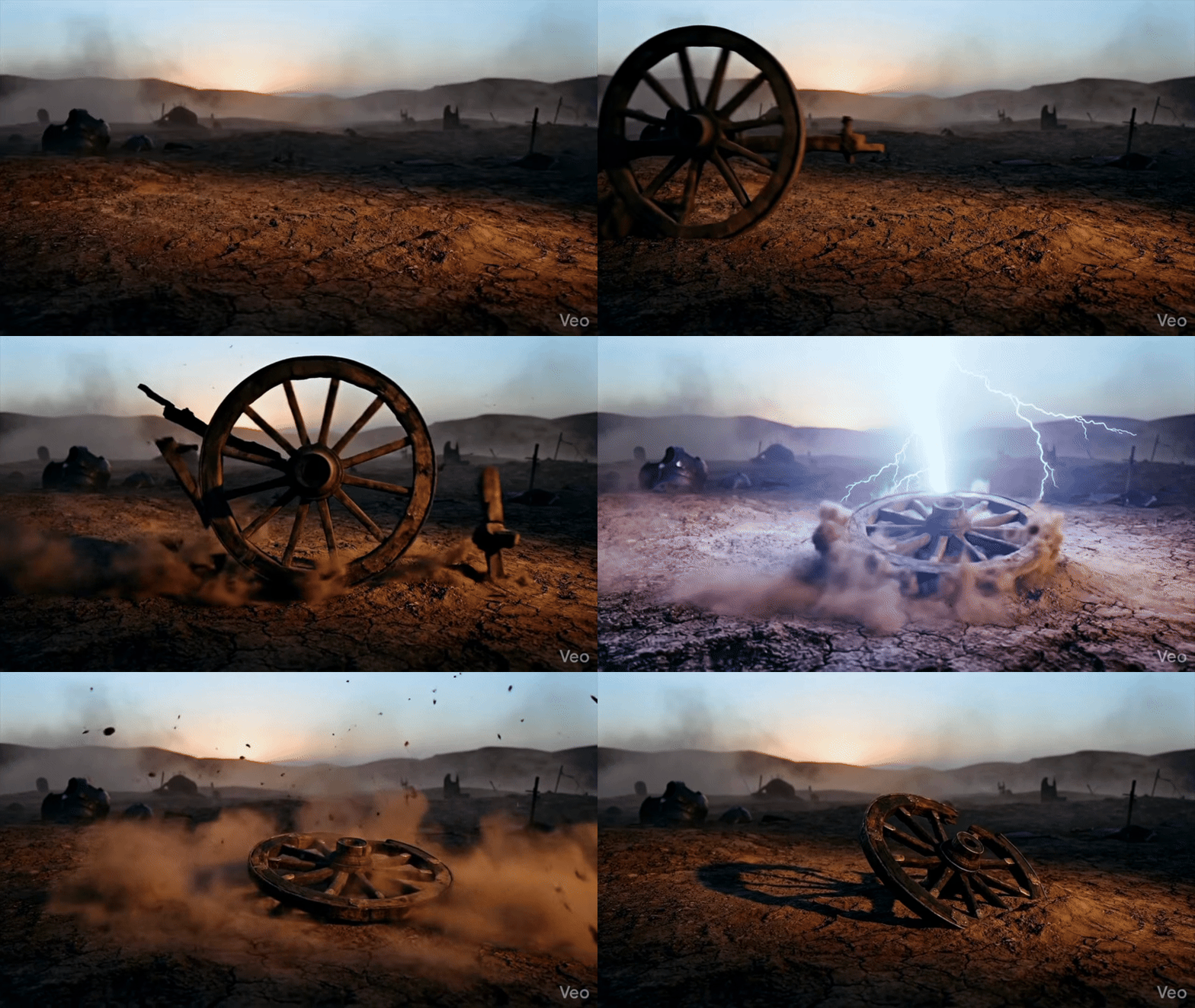
Yudhishtara, the eldest of the Pandava brothers, known for his righteousness all his life, speaks a half-truth to get an advantage. His chariot — which had always floated above the earth as a mark of his righteousness — touches the ground in that moment. It never rises again.
Arjuna abandons restraint.
Karna and rest of the Kauravas fight beyond code.
Krishna instructs action beyond dharma.
The loop resolves. The ethics do not.
This is Part Two of a three-part exploration into systems, survival, and sovereignty. Read Part I The Wound here
Read Part Three: The Mirror on wavypix.com. when it is available.
Follow me at https://WavyPix.com https://wavypix.substack.com/
The Tragedy of Intelligence: From the Padma-Vyūha to the Age of AI - Part 3 of 3
On the boundary of the local sphere, the taming of central empires, and why the sovereign …
The Tragedy of Intelligence: From the Padma-Vyūha to the Age of AI - Part 1 of 3
On incomplete maps, wars you did not choose, and who builds the exit
Ekalavya - The Arrow That Never Flew
On the comfort of infinite potential, the friction of the workbench, and how we traded the …
The Backdoors of the Future
A backdoor created by a model does not care who uses it later. It is just an AI-generated …
Anatomy of a Prompt: Chapter 3 - The Model Wars
The Model War is not about the smartest engine. It is about who wires the house, who owns …