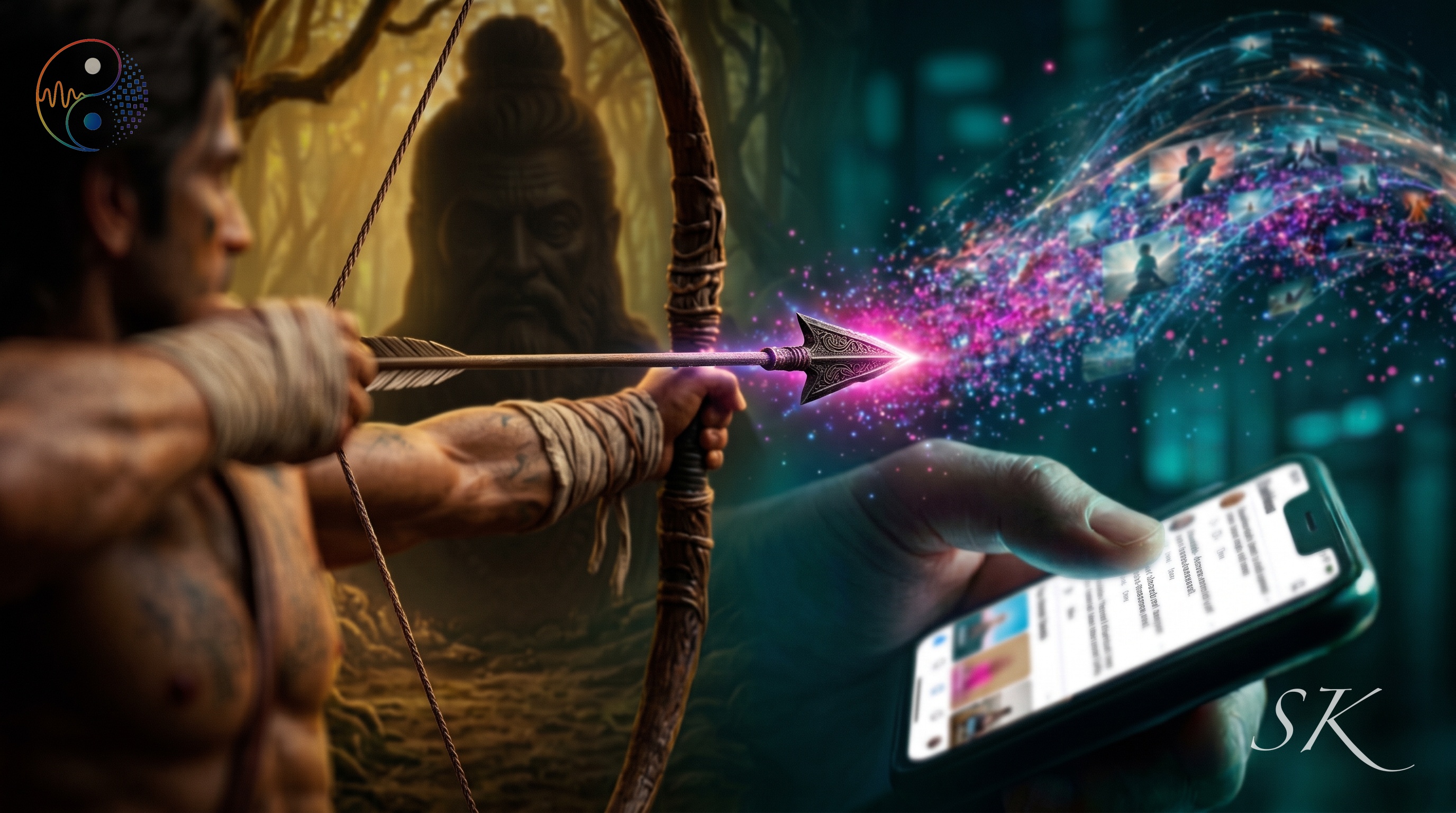
“What I cannot create, I do not understand.” — Richard P. Feynman
Don’t have the time to read the entire article? You can listen to it here.
The Archer’s Craft
The thick bushes rustled, breaking the sounds of the forest. A silent shadow started to emerge from behind the undergrowth. Arjuna quickly spun his horse around, the string of his bow fully drawn, aiming the arrow into the direction of the disturbance. His brothers and cousins halted their horses in anticipation. Finally their wait was about to end on their royal hunt.
What stepped out into the clearing was no beast of prey. Arrows slowly emerged from the brush, followed by a dog. At first glance, it appeared as though the animal were carrying a cluster of reeds in its jaws. But as it ran closer, it got clearer.
The dog’s jaws were held open in an intricate, cage-like lattice of seven arrows. It showed no pain and made no sound, trotting forward without distress. Arjuna lowered his bow, got down into the dirt, and gently embraced the animal. There was not a single drop of blood.
Dronacharya, the royal guru, inspected the work closely. Even he could not hide his astonishment. The shafts had been delivered in such rapid succession that the animal had been silenced instantly in mid-breath. And it was clear the archer had no desire to harm the dog but only to mute it.
The dog had barked. That was the whole offense.
Dronacharya had never taught such a skill to anyone, not even to Arjuna, his most favorite pupil. Troubled by the discovery, Drona led the group deeper into the forest. He would find this archer.
Standing in a small clearing was Ekalavya. A Nishada prince, no older than Arjuna, barred from the royal academy because of the lineage into which he had been born.
He held a rough bow carved from forest timber, his eyes fixed on a mark etched into a distant tree trunk. Beside him, resting on a mound of earth, was a lump of dried river mud crudely sculpted into the bust of a bearded master.
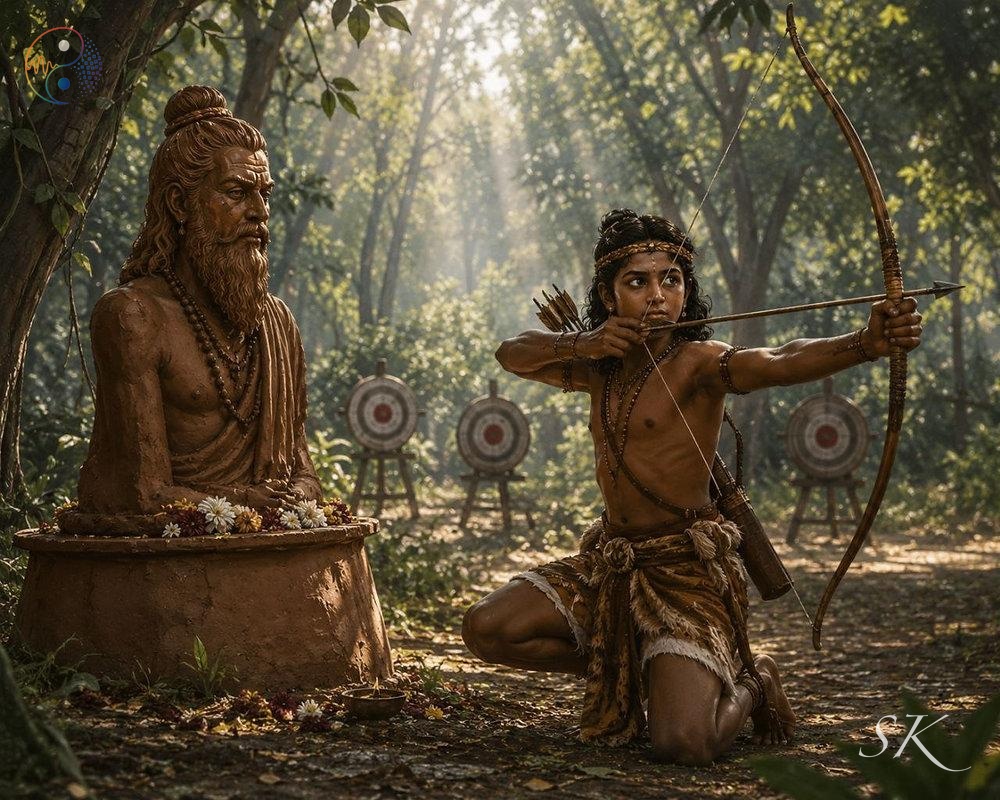
Ekalavya drew the string, pulling smoothly past his cheek until the wood creaked. The bow held at full draw, waiting for the instant of release, its infinite potential coiled into tension.
Footsteps broke through the dry leaves behind him, the boy slowly turned around, easing the tension in the bow letting go of all the potential in the arrow.
Drona’s gaze drifted from the boy to the rough clay idol behind the boy. Every one around him could see the unmistakable resemblance between the idol and the royal guru.
Drona felt pride and could not stop himself from marveling the boy’s dedication, for a very tiny moment.
We are usually told this story to praise the virtue of devotion. We are told that with enough reverence, even a lump of dried mud can become a teacher.
That is the nursery version. It is what I, along with so many others, was told growing up. The story also tries to instill in the listener the reverence and gratitude a student has to show towards his teacher.
The real story is darker, simpler, and needs some more attention.
Ekalavya, the Nishada prince whom the royal guru had refused to accept as a student, took the education for himself. He made a clay statue of the master and practiced in front of the watchful eyes of the statue. He practiced until his fingers split and hardened into calluses.
He did not ask for approval. He refused to accept the imposed traditions. He converted raw, distant observation into sovereign physical reality.
Depending on the point of view of the audience, either he was trying to use the statue as a proxy to the teacher or he was trying to prove a point.
Either way, everything changed for him in unexpected ways, the moment he used his self-taught skills to silence that dog.
The Modern Ekalavya’s Bottomless Ingestion Machine
Today, we inhabit the inverse universe. We do not lack the teacher.
Every masterclass ever recorded, every nuance of craft, every dissection of cinematography, story arc, and hero’s journey sits illuminated three inches from our retinas.
We watch series of short video essays explaining how Kubrick lit a scene for a film with practical candlelight. We scroll through forty-part series dissecting the art and craft of the Renaissance masters. We save hundreds of short-form tutorials even before getting out of bed, consuming petabytes of information, every day.

The intake is limitless and frictionless. Yet remarkably little ever crosses the threshold from the screen into the physical world.
Somehow that high level of dopamine hit rarely transforms into the real-world practice.
Maybe there is a half-truth in the justification that this is for our pleasure and not everything has to have a worldly transition.
The brain easily finds satisfaction in the dopamine hit of watching a craftsman shape clay on a high-refresh OLED screen. But the hands remain clean and idle. They never get to experience and feel the fine touch and gratification from achieving any outcome, even on a basic level.
The hoarding of the work of others becomes arrows of bookmarks that we probably never visit again.
Somehow holding onto potential is simply far more comfortable than facing the friction of the workbench.
“If I asked you about art, you’d probably give me the skinny on every art book ever written. Michelangelo? But I’ll bet you can’t tell me what it smells like in the Sistine Chapel. You’ve never actually stood there and looked up at that beautiful ceiling.” — Sean Maguire played by Robin Williams, Film: Good Will Hunting, 1997
The Wave and the Terror of the Particle
Because somehow potential feels safer.
As long as we are reading that third book on screenwriting, our own screenplay remains flawless in our heads. It contains no awkward dialogue. It has no structural dead ends. It floats in our consciousness as a wave of infinite potential.
We can be Shakespeare in the morning and Christopher Nolan by dinner, because nothing has been committed to the page.
The wave of potential gives us the false identity that we could one day deliver on a vast canvas. Creation, by contrast, is an act of commitment that has a very high probability of failure rate than success.
To create is to take that infinite wave and collapse it into a single, clumsy, embarrassing particle of action. The moment the ink touches the paper or the finger presses the shutter, reality steps in. The line sounds hollow. The lighting is flat. The code breaks at runtime.
The particle is small, fragile, and uniquely yours to defend.
It is far easier to linger in the warmth of potentiality, reassuring ourselves that we are “still researching,” “still gathering references,” or “getting the taste right.”
It is an innocent self-deception, seeking refuge from the friction of the world.
Ekalavya had no luxury for all of this. He had only the mud, the bow, and the clearing.
He practiced before the clay statue of Drona because he needed an anchor for his own relentless practice. He did not seek external validation.
The silence fell over everyone and the forest stood still for a moment as the words were uttered.
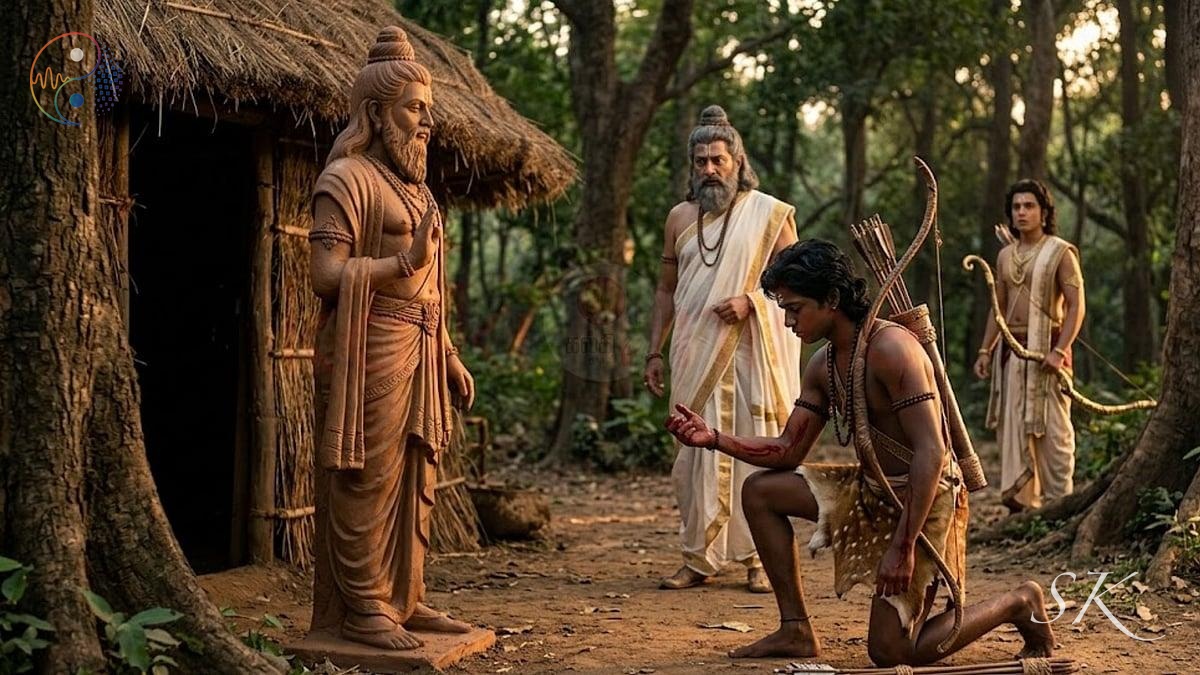
“Yes, your thumb,” said Drona.
The master was asking for Guru Dakshina—the master’s fee. While it was a custom to pay whatever the teacher wished for, here he was asking to pay a fee in return for a skill he did not teach. He was claiming it because Ekalavya used his statue as a proxy to his teachings.
Drona had made a promise that his favorite disciple Arjuna would be the unparalleled archer in the world, with no equivalents. And so he asked for the one thing that would make it possible.
“Yes, your right thumb,” said Drona.
Even Arjuna could not believe his ears.
The Willing Sacrifice
Did Drona take it or did Ekalavya let him take it? It does not matter.
Without his thumb, the grip was broken, the draw undone. The tendon of sovereign mastery was severed so that Arjuna would remain unchallenged. Call it institutional gatekeeping, a monopoly on mastery protected at the root.
The Tragedy Of The Modern Era
No master had ever walked out of an academy to demand our thumbs.
We offered our thumbs voluntarily.
We took the thumb—the evolutionary marvel of the human hand, the exact anatomical hinge that enabled our ancestors to grip the chisel, carve the bone flute, notch the arrow, and build civilization—and we transformed it into a scroll wheel.
Our thumb rarely draws a bowstring. It rarely guides a brush or shapes raw wood. Instead, it sweeps upward across a pane of smooth glass, sixty times a minute, clearing away one fragment of ephemeral content to make room for another.

We surrendered the primary instrument of human agency in exchange for an infinite sequence of micro-dopamine loops.
We did not need a royal guru to disarm us. We disarmed ourselves in the quiet glow of our own screens.
The Exit
There is no algorithm that will rescue us from this loop. The platforms are operating precisely as designed: monetizing the gap between intention and execution. A mind permanently suspended in potential is the ideal consumer, because the moment it commits to finishing a real project, it will close the feed.
Maybe it is time to stop watching another tutorial on color grading and just get out to capture a scene and sit with its imperfections.
Forget the thread on prose cadence. Open a blank page and draft three sentences that are yours.
Maybe it is time to endure the awkwardness of failed attempts, and pick up the bow to pull something real. If it does not hit the intended target, maybe we can make the target the intention.
Ekalavya did not wait for Drona’s permission. And when his thumb was taken, ancient lore tells us he learned to draw the bow using his index and middle fingers and kept shooting.
Beyond this, Ekalavya largely vanishes from the epic of the Mahabharata. His story is a tiny speck in the epic, told as a virtue to learn determination towards one’s goals and to show reverence and gratitude towards the learnings in life. Or maybe Vyasa, one of the greatest writers of the human history, was probably teaching us how to write depth to the characters, even to the ones in supporting roles.
Take your pick.
“What I cannot create, I do not understand.” — Richard P. Feynman
The Tragedy of Intelligence: From the Padma-Vyūha to the Age of AI - Part 3 of 3
On the boundary of the local sphere, the taming of central empires, and why the sovereign …
The Tragedy of Intelligence: From the Padma-Vyūha to the Age of AI - Part 2 of 3
On the architecture of the trap, the illusion of the visible exit, and why the loop scales …
The Tragedy of Intelligence: From the Padma-Vyūha to the Age of AI - Part 1 of 3
On incomplete maps, wars you did not choose, and who builds the exit
The Backdoors of the Future
A backdoor created by a model does not care who uses it later. It is just an AI-generated …
Anatomy of a Prompt: Chapter 3 - The Model Wars
The Model War is not about the smartest engine. It is about who wires the house, who owns …